|
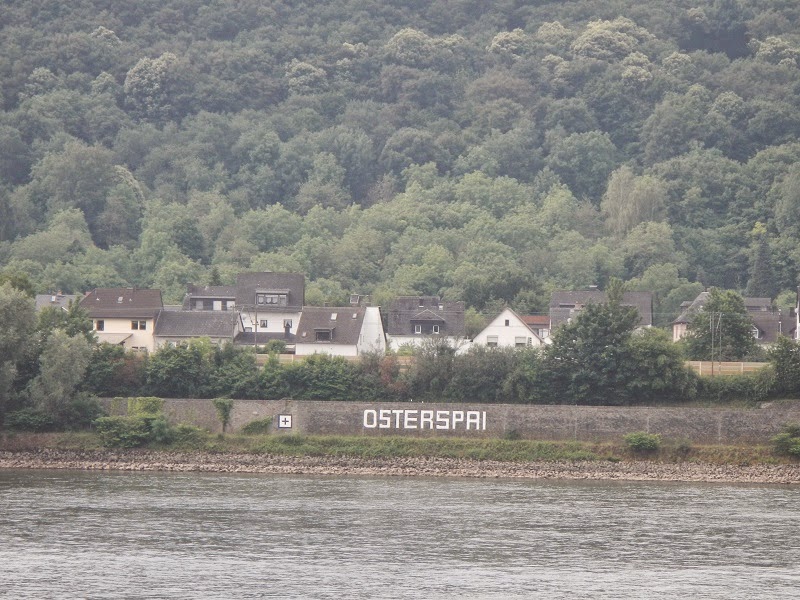
| At first I thought that this was the Moselle River but it was just a side branch of the Rhine. |
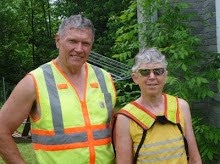
I continued into Koblenz following behind Joachim and Elka.
I would stop and take a photo and then bike fast to catch up to them again.
 |
|
Dedication to Kaiserin Augusta Anlagen
|
 |
|
Following Joachim and Elka toward Koblenz
|
 |
|
The city of Ehrenbreitstein on the other side of the river
|
 |
|
The old medieval wall outside the Grand Cafe in Koblenz--Koblenz
also spelled Coblenz(English) or Coblence (French) is a German city situated on
both sides of the Rhine at its confluence with the Moselle, where the Deutsches
Eck ( German Corner) and its monument (Emperor William I on horseback) are situated.
As Koblenz was one of the military posts established by Drusus about 8 BC, the
city celebrated its 2000th anniversary in 1992. The name Koblenz originates
from Latin (ad) confluentes, confluence or "(at the ) merging of rivers.
It is the 3rd largest city in the state of Rhineland-Palatinate with a
population of 106,000. It has a long historical record. It was heavily bombed
during the World War II and rebuilt later. Koblenz is a principal seat of the
Moselle and Rhenish wine trade, and also does a large business in the export of
mineral waters. It also manufactures automotive parts, aluminum coils, pianos,
paper, cardboard, machinery, boats and barges. Since the 17th century, it has
been home to the Konigsbacher brewery. The headquarters of the German Army
Forces Command is located in the city.
|

 |
|
Ehrenbreitstein Fortress on the hill over the
river--Koblenz's defensive works are extensive, and consist of strong forts
crowning the hills encircling the city to the west and the citadel of
Ehrenbreitstein on the opposite bank.
|
 |
|
Koblenz-high court and court house
|
 |
|
French in 1801 built Ehrenbreitstein fortress. It was built 118
meters above the Rhine River on Ehrenbreitstein mountain as the backbone
of the regional fortification Zoom shot of Fortress Ehrenbreitstein--Occupying
the position of an earlier fortress destroyed by the system by Prussia between
1817 and 1828 and guarded the Middle Rhine region, In the 16th century work
began to change the castle into a fortress that could withstand the new
gunpowder weapons. During World War II the fortress served as a place of
safekeeping for archives and cultural objects. In 1946-50 it served as a
refugee camp , in 1950-60 as residential housing , in 1952 part was a
youth hostel, in 1956 a museum . Between 2007-11 there was a restoration done
and today it is open to visitors and has several museums and a restaurant
offering a Baroque dining experience and offering regional wine. It also serves
as a venue for open air concerts and plays.
|
 |
|
Cable cars from Koblenz side of river taking tourists to the
castle--The Koblenz Cable Car is Germany's biggest aerial tramway.
|
 |
|
Kaiser Willem I statue--In 1897 this monument of German
Emperor William I on a 14 meter high horse was inaugurated by his grandson
William II. In 1945, the statue was badly damaged by an American artillery
shell. Soon afterwards it as completely taken down. In 1949 it was replaced by
the German national flag but in 1993, a new statue was erected funded by
a couple , Werner and Anneliese Theisen of Koblenz.
|
 |
|
Taking a break at the Deutsches Eck- the place where the
Moselle River flows into the Rhine River. The Deutsches Eck (German Corner) is
at the headland of the 2 rivers and is a piece of land symbolizing the
foundation of the German Empire,showing German unity and the German
refusal of any French claims to the area. All the flags of the 16 (Lander)
states of Germany fly around the perimeter of the area as well as a big
national flag.
|
 |
|
Looking at the Moselle River and the steeples of Pfarramt
St. Kastor (Basilica of St. Castor) Catholic church on the right and
Liebfrauenkirche on the left
|
 |
|
The Moselle River flowing into the Rhine River
|
 |
|
Instead of cycling farther down and over a bridge, Joachim,
Elka and I took a small ferry across the Moselle to the other side.
|
 |
|
More angels at work here!! The ferry man and Joachim lifted
Silver up the steep steps to the top.
|
 |
|
A last view of the Deutsches Eck with the statue and the
castle over the river
|